The Boomer Archaeologist: Q&A with Tom Levy

UC San Diego Qualcomm Institute (QI) affiliate Tom Levy, co-director of the Center for Cyber-Archaeology and Sustainability and distinguished professor in the Division of Graduate Studies, chatted with QI Director of Communications Mika Ono about his recently published graphic memoir, “The Boomer Archaeologist: A Graphic Memoir of Tribes, Identity and the Holy Lands” (Equinox, 2025). This interview has been edited for length and clarity.
MIKA ONO: What inspired you to write your memoir?
TOM LEVY: When I was going through the process of retiring from teaching, I thought, “I had better write my story down. I had better do this before I’m too old and forget it all!” It was really an enjoyable project. It was more like a hobby as opposed to work. Now we are editing a book based on the recent Exodus conference held here at QI, which is going to be fun and enjoyable, but it’s different.
ONO: Who is the memoir’s intended audience?
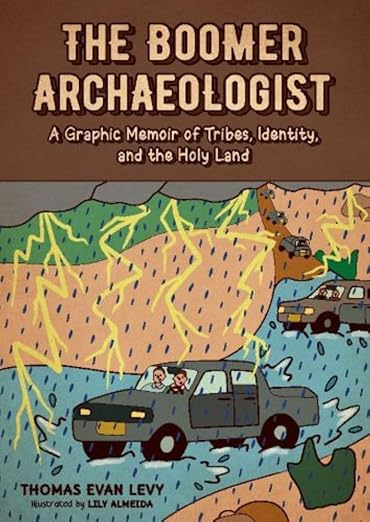
LEVY: The book has different layers. First, it is aimed at my sons and granddaughter. Then it reflects on changes in how archeologists interpret the past, different theoretical frameworks used to interpret the past during the 20th and 21st centuries, how I played around with them, and what I subscribe to today. So, if students read it, they will get a good view of how the field has evolved, all the way up to cyber-archeology today. It could be assigned reading in introductory archaeology courses.
Another intended audience is the Jewish world. There are a lot of tensions and different viewpoints, and I think it’s worth it for members of this community to consider the perspective presented in the book.
I’m also a member of the Explorers Club, and that’s another audience, since there’s a lot of adventure in the book.
Finally, I would love for members of my generation, the Baby Boomers, to read it because I think they would see themselves. It’s not just my journey; it’s our journey — people my age who have been through episodes from the Vietnam War to different events in the history of the United States over the last 50-plus years.
ONO: I thought it was interesting how history wove its way through your life. That might be true for everyone, but in the memoir you could see your personal journey being influenced by these big historical currents.
LEVY: Absolutely. A friend of mine at the University of Haifa, Guy Bar-Oz, has referred to me as the “Forest Gump of Archaeology” because of my timing. In 1972, when Black September Palestinian terrorists killed Israeli athletes at the Munich Olympics, I was at a small university in San Fernando Valley. I said to my friends, “Can you believe this?” They replied, “Oh, those Israeli athletes got what they deserve.” I was gobsmacked. That influenced me to immediately leave that college. I was lucky to get into the University of Arizona, which was one of the best for archaeology.
I was in Greece during the 1973 Yom Kippur War. I decided I was going to volunteer—not for the army, but to milk cows on a kibbutz. By the way, the singer Leonard Cohen was also in Greece at the same time. He was 39 and I was 20. Cohen also went to Israel to volunteer on a kibbutz, however someone recognized him in a Tel Aviv coffee shop, and he immediately ended up performing for the troops in the Sinai desert.
I was in Israel during the First Intifada. Most recently, I was there on October 7, 2023. I just fell into these places and met some really cool people during the journey.
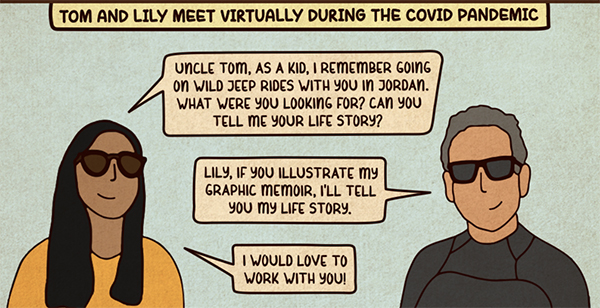
ONO: Your niece, Lily Almeida, illustrated the book. That seems like a fun relationship that made it into the story.
LEVY: That was great. Lily is very talented. We worked on the memoir remotely during COVID; she was in London and I was in San Diego.
ONO: Another unusual aspect of your memoir is that it has been published by a commercial publisher, Equinox.
LEVY: The publisher is in England. They’re not Jewish, but I’ve worked with them for quite a few years, and I have had a lot of out-of-the-box publication projects with them that were successful. While they were hesitant about the memoir at first, when I showed them the graphics and layout, they said, “We want to do it.” I was excited. I didn’t want to go the self-publishing route, especially since publishing a graphic work in the electronic age is very complex.
ONO: How did you decide on a graphic format?
LEVY: I read a review of a graphic memoir in the Times of Israel called “The English GI.” It was about a Jewish guy from England who came to America in 1941, got stuck here, and then was drafted into the American army. I loved the layout of the book, and I ended up using the same book designer, BK Suru in India. I’ve always loved comics and really had fun with the format. I’d have an idea and lay it out in PowerPoint. For example, I’d remember my father and I used to shoot Dos Equis beer bottles north of L.A.; then I’d go on the internet to find images of the bottles and put them in layout.
ONO: You were part of the illustration team, in a way.
LEVY: I designed every single frame. I laid it all out so I could reflect on it. Then Lily would draw it with her beautiful art style and scale it properly.
ONO: Did the chapter divisions come from you, too? We all have different chapters of our lives.
LEVY: Yes, I was thinking about how to organize the stories, including certain scenes.
ONO: The time when your uncle tried to flush your head down the toilet was laugh-out-loud funny.
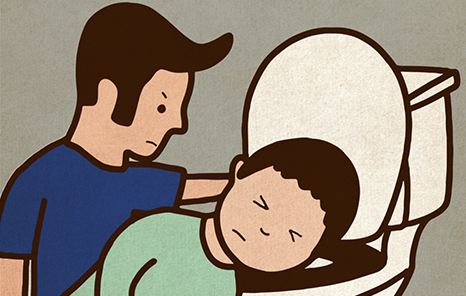
LEVY: I saw my uncle about four months ago, and now he’s in his early 80s. I said to him, “Steve, do you remember when you and your buddies would force me to smoke a cigarette when I was five?” “Oh, no, no. I don’t remember.” “How about when my parents went away and left me in your care, and you would try to flush my head down the toilet? It was your joke, ‘At the top of Tom’s forehead, it says American Standard.’” He didn’t remember a thing; he had erased it all.
ONO: You had some amazing feedback in the book blurbs. Is there a theme to how people are responding?
LEVY: I think people are surprised how fun the memoir is, but it also has a lot of messages. If professors made it required reading for students, students would get a kick out of it.
ONO: Say more about archaeo-diplomacy. How did you come upon that?
LEVY: I believe when we work with another culture, we’re representatives of our country. When we spend time in these other places — Greece, Israel, Jordan —we come to love those cultures. At home, you become a kind of ambassador for these places. With archaeology as a field science, we spend 24/7 not in a hotel, but in my case, out in remote areas living in tents interacting with the Bedouin and so on. That’s how I came up with the idea of archaeo-diplomacy. Archaeology can be a unifier, especially when grounded in certain periods of time, like the Neolithic Revolution.Everybody’s interested in it — it doesn’t matter if you’re sitting in Syria, Lebanon or Morocco; it’s like we speak the same language.
ONO: The memoir talks about the early influences in your childhood that led you to archaeology. But you’re a curious person. Do you think there’s something special that we can learn from archaeology about ourselves or how we got here?
LEVY: Yes, we didn’t arrive here yesterday. Part of the problem with the political climate on campuses today is that many students lack an understanding of history over the last 100 years, let alone thousands of years. So many students have no understanding of the complexity of the past. History, in general, is a very important field, if you approach it as objectively as you can. The same is true with archaeology. The further you go back in time, the fewer documents you have, and soon you reach a period when it’s just material culture. So how do we read the material culture for social meanings? That’s what anthropological archaeology is all about. We can learn a lot about who we are, how we got here, how people use resources and technology, how people interact, and how we adapt to climate, environmental and cultural change. In different time slices, archaeology can tell us a lot about the different ways people met these challenges. Even in the biblical periods, the archaeology of the emergence of ancient Israel and the formation of the earliest Hebrew kingdom show fights between the Philistines and the Israelites. It’s about this chessboard called the southern Levant and how people through time have interacted in this small area.
ONO: It’s an amazingly rich area, culturally. Why is that? Are there lots of resources?
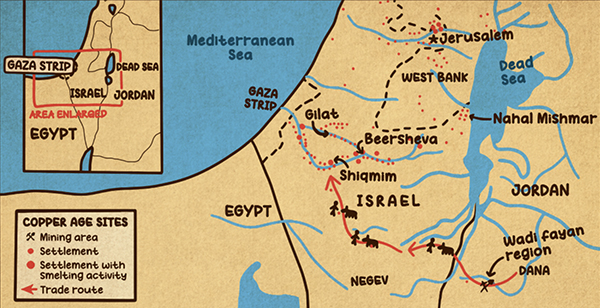
LEVY: No, the joke is that when Moses came down from Sinai, instead of going right to the Arabian Peninsula with all the oil resources, he went left, and there’s nothing. Jews, Muslims and Christians call it the “Holy Land.” There are many other holy lands. Here in California, for Native Americans, it’s Mount Shasta and its surrounding areas. The whole of India can be conceptualized as a holy land. But the southern Levant is the land bridge between Africa and Asia. From the beginnings of prehistory, when humans traveled out of Africa, that’s the road they took. This area has been a byway for over 1.4 million years. Then you have the Mediterranean Sea, which was a maritime highway of interaction among all the cultures around the Mediterranean. It’s an amazing place. Being able to work there is a real privilege.
ONO: So it’s really a crossroads.
LEVY: Yes. It’s so rich in terms of cultural evolution because people have been there for so long. Some other areas just don’t have that kind of deep time. They have fascinating problems, but it’s not like the eastern Mediterranean, where you have the rise of Egyptian civilization, the Hittites, the Mycenaean Greeks, all these little Iron Age kingdoms — Phoenicia, the Philistines, the Israelites, the Edomites, the Moabites — interacting.
ONO: If you were to isolate a couple big questions in the archaeology of the area, what would they be?
LEVY: One of them is the rise of social inequality. How is it that we develop the kind of hierarchical societies that laid the groundwork for our societies today? That’s a huge question. You can ask that question all over the world, wherever you had the rise of real complex societies and civilizations.
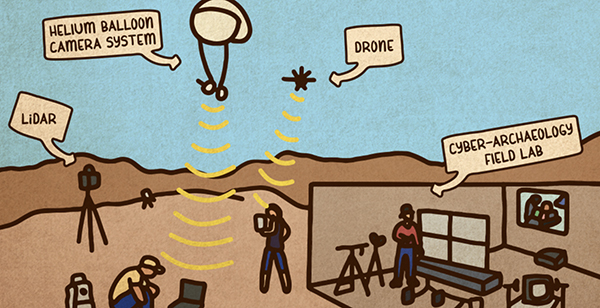
Other big questions include how societies adapt to the collapse of civilization. That’s something to think about. We have two great examples. At the end of the Early Bronze Age, around 2300 BCE, there’s social collapse. Then again, at the end of the Late Bronze Age, around 1200 BCE, the New Kingdom of Egypt, the Hittites and the Mycenaeans collapsed. That opened power vacuums for new societies to evolve. We can ask, “What did people develop to be able to adapt to these radical changes, which could have started because of climate change, pandemics or poor leadership?”
So those are some of the big questions we can work on. It’s amazing; recently, we found a series of Iron Age wrecks underwater off the coast of Israel, near a place called Tel Dor, and each of those ancient cargoes is a snapshot in time of social interaction, economy and the evolution of technology. Those are interesting things to look at.
ONO: It strikes me that humans haven’t changed that much.
LEVY: You’re right, but technologies have accelerated so fast, and right now understanding how people have adapted to technological change in general is an important topic.
ONO: What have you found about that?
LEVY: We’ve looked at the invention of metallurgy and its development as a lens to examine how societies evolve. In some cases, it was a prime driver for change, certainly for the ancient Edomites who are mentioned in the Hebrew Bible. They lived in southern Jordan and Israel, and had a monopoly on copper production for quite a while, which gave them a lot of agency and power. From the historical records, it seems to have attracted King David’s interest in conquering that area in the 10th century BCE to acquire resources and become part of that action.
ONO: What’s your next project?
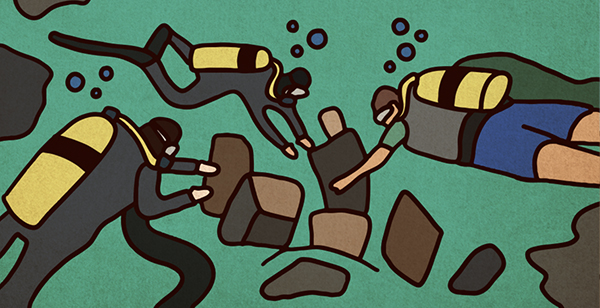
LEVY: My big project is helping the University of Haifa establish the National Center of Marine Archaeology for the Eastern Mediterranean, off the Carmel Coast. I am passionate about that. One of the things that really animates the project is the idea that we’re going to interact with scholars, researchers, students and so on from all the countries around the Mediterranean, exploring Mediterranean civilizations from remote antiquity to today.
Archaeologically, my next project will be in early September. We’re going to do an underwater survey for Neolithic sites off the coast of Israel. In October, I would like to return to Greece to do a paleo-environmental project with Greek, American and Israeli colleagues on a tiny Greek island, which I mentioned in my memoir. I wanted to study it when I was a graduate student almost 50 years ago. It didn’t work out then, but now my colleagues in Greece want to collaborate, so we’ll see if that’s possible.
For more information on Levy, see his bio. For more information on “The Boomer Archaeologist,” visit the Equinox website. The e-book is available for a 25% discount at https://equinoxonlinelibrary.com/book/58293/the-boomer-archaeologist with code 2893-25. Print version pre-orders are available for a 25% discount at https://www.isdistribution.com/BookDetail.aspx?aId=187523 with code 2893-25 for North American buyers; UK and worldwide buyers can visit https://www.equinoxpub.com/home/boomer-archaeologist and use code 2893-25.
The views expressed in this article are those of the speakers and do not necessarily represent those of UC San Diego or its Qualcomm Institute.